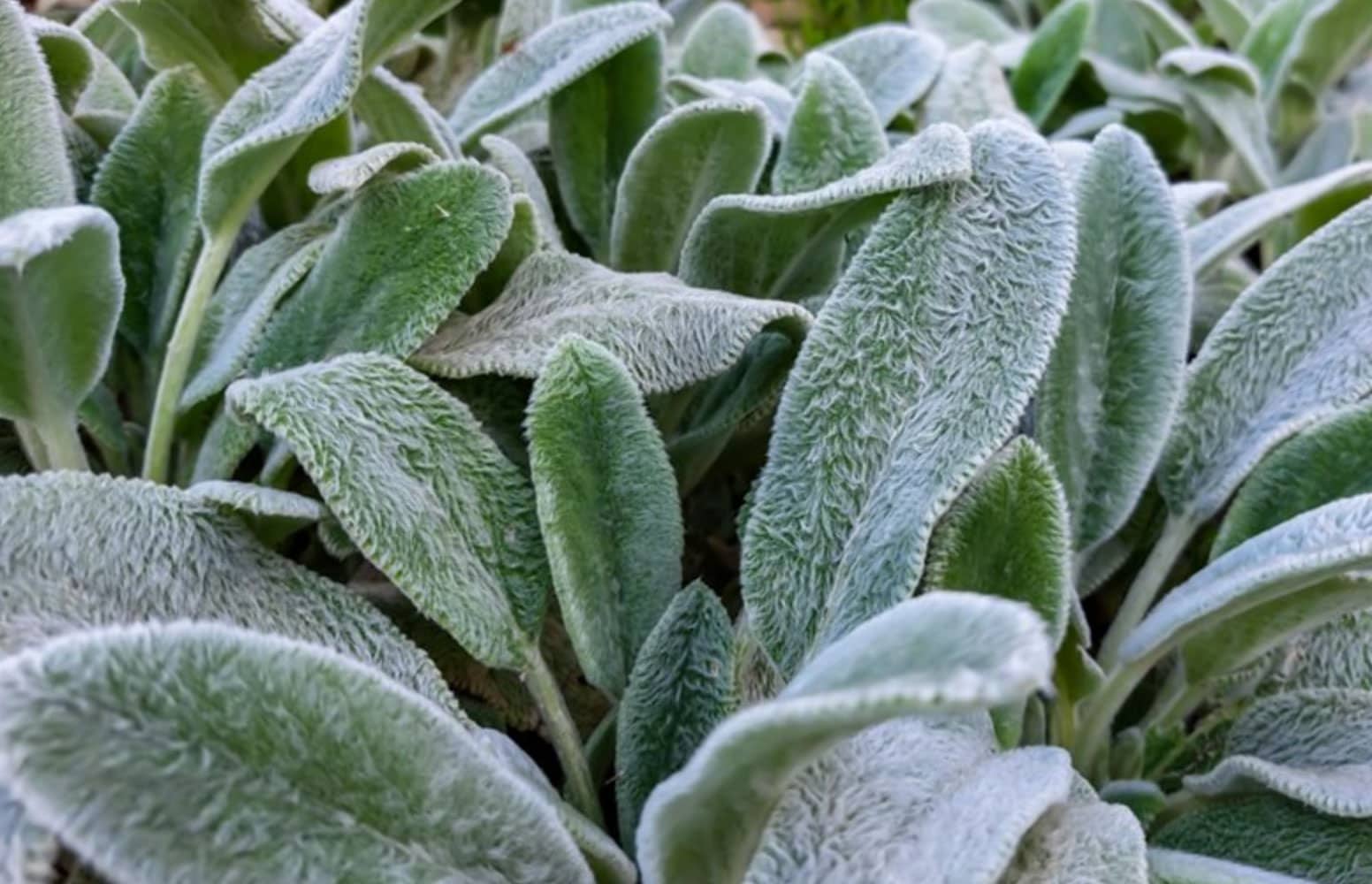
Lamb’s ears (Stachys byzantina) are one of the most reliable silver-foliage groundcovers for a Melbourne garden. How to plant lamb’s ears comes down to four things: plant them in autumn or early spring, in full sun, in soil that drains sharply, spaced 30–45 cm apart depending on how quickly you want cover. Water through the first summer, then leave them alone. The single biggest mistake we see is treating them too well.
We’ve been designing and building gardens across Melbourne’s inner and north-eastern suburbs for more than 20 years, and lamb’s ears turn up in a lot of our planting plans. They’re also one of the plants we’re asked to replace most often — almost always because they were planted in the wrong soil, fed too generously, or mulched with the wrong material.
This guide covers what actually works in Melbourne conditions, including a few points where the standard advice will let you down.
Lamb’s ears at a glance
| Botanical name | Stachys byzantina (syn. Stachys lanata) |
|---|---|
| Family | Lamiaceae (mint family) |
| Origin | Turkey, Armenia and Iran |
| Type | Evergreen perennial groundcover |
| Height | 20–30 cm foliage; 40–60 cm in flower |
| Spread | 45–90 cm per plant, depending on cultivar |
| Position | Full sun (minimum 6 hours) |
| Soil | Free-draining, low fertility, pH 6.5–7.5 |
| Water | Low once established |
| Frost | Fully hardy across all Melbourne suburbs |
| Flowering | Late spring into summer, mauve-pink spikes |
| Pet safe | Yes — non-toxic to cats and dogs |
| Weed risk in Victoria | Not listed as an environmental weed |
When to plant lamb’s ears in Melbourne
You’ll see “plant anytime” on a lot of Australian growing guides. That’s true in the narrow sense that the plant is tough enough to survive it, but it isn’t how you get the best result.
Autumn (March to May) is the best planting window in Melbourne. The soil is still warm from summer, which drives root growth, and the winter rain that follows does the establishment work for you. By the plant’s first real summer, the roots are deep enough to cope on their own.
Early spring (September to October) is the second-best option. It works, but you’re committing to watering through the first summer.
Avoid planting into the middle of summer, when a shallow-rooted new plant has to survive a run of 35 °C days. And avoid mid-winter planting on the heavy clay soils common through Melbourne’s west and north — cold, waterlogged ground will rot the crown before the plant establishes.
Where to plant lamb’s ears
Sun
Full sun gives the best silver colour. In shade, the foliage fades toward green, the plant stretches and thins, and it becomes far more susceptible to fungal problems. Light afternoon shade is tolerated in hotter northern suburbs. Anything deeper will disappoint you.
Drainage is the whole game
Lamb’s ears evolved on dry, stony hillsides. They’ll tolerate poor soil, heat, wind and neglect. What they won’t tolerate is sitting wet — and this is where Melbourne gardens divide sharply.
On sandy soils — the bayside strip and pockets of Melbourne’s sandier east — you already have what this plant wants. Plant straight into the ground.
On clay — which covers a great deal of Melbourne, including much of the established north-east through Heidelberg, Ivanhoe and Eaglemont, and the heavier basalt soils further west — you need to intervene. In order of effectiveness:
- Raise the planting position. Even 15–20 cm of mounding transforms the outcome. On our own projects, this is the fix we reach for first, and it’s more reliable than any soil amendment.
- Open the soil structure. Fork through gypsum at the rate on the bag, plus coarse washed sand or 7 mm scoria.
- Use a slope, rockery or retaining wall edge. Anywhere water naturally runs away suits them perfectly. Lamb’s ears are an excellent plant for softening the top or base of a retaining wall.
Airflow
Those felted leaves hold moisture against their own surface. Plants crammed against a fence, wedged behind a dense shrub, or squeezed into a still corner will develop leaf rot during Melbourne’s humid late-summer spells. Give them open air.
How to plant lamb’s ears: step by step
- Water the plant in its pot an hour beforehand, so the rootball is moist but not saturated.
- Prepare the site — clear weeds, and mound or amend the soil if you’re on clay.
- Dig a hole twice the width of the pot and the same depth. No deeper.
- Remove the plant and gently tease the outer roots if they’re circling.
- Set the crown at or slightly above soil level. Never bury it. A buried crown is a rotted crown by August.
- Backfill and firm gently with your fingers. Don’t compact it hard.
- Do not build a watering well or basin around the plant. This is standard advice for most new plantings and it’s wrong for this one — you’d be deliberately holding water against a plant that dies from exactly that.
- Water in once to settle the soil around the roots.
- Mulch with gravel, not bark. A 2–3 cm layer of pea gravel, crushed granite or scoria keeps the surface dry and the lower leaves clean. Keep it clear of the crown itself.
The two mistakes worth calling out
Don’t enrich the soil. Most growing guides will tell you to dig in compost, manure or a pelletised fertiliser before planting. For lamb’s ears, that advice actively harms the plant. Rich soil produces soft, leggy growth, a floppy habit, and far more spreading than you want. Poor soil produces the tight, silver, compact plant you’re actually after.
Don’t mulch with bark, sugarcane or pea straw. Organic mulches hold moisture at the soil surface, which is the precise condition that rots the lower leaves and crown. Gravel does the opposite. If you’re mulching a mixed bed with bark, keep a clear gravel collar around your lamb’s ears.
Both of these are worth flagging because they appear in widely-read guides — usually ones published by fertiliser and potting mix brands, where the advice is shaped by the product being sold.
Spacing: why the advice varies so much
You’ll find spacing recommendations for lamb’s ears ranging from 30 cm to 60 cm, which is confusing until you understand that they’re answering different questions.
- 30–35 cm apart — fastest continuous cover, typically knitting together in 12–18 months. Best for edging and mass groundcover. Slightly higher humidity between plants, so only use this spacing in an open, sunny position.
- 45–60 cm apart — plants develop as distinct silver mounds before merging, usually taking 2–3 years to close up. Better airflow, better long-term health, and a more considered look in a designed bed.
For most residential planting on Melbourne clay, we’d lean toward the wider spacing. It’s slower to look finished, but the plants stay healthier and you’ll be dividing them less often.
For larger areas, plant in a staggered triangular grid rather than straight rows — it closes gaps faster and reads less rigidly.
Watering
First summer: a deep soak once a week is plenty in most Melbourne soils. Water at the base, in the morning, and keep the foliage dry. Overhead sprinklers and woolly leaves are a poor combination.
Established plants: close to nothing. A mature clump will get through a Melbourne summer on rainfall alone, wanting only an occasional deep soak during an extended heatwave. If the leaves flatten and look tired in February, one deep watering will bring them back.
Feeding: none required. Some guides recommend weekly liquid feeding through the growing season. For a drought-adapted Mediterranean-climate plant growing in deliberately poor soil, that’s counterproductive. At most, a light application of slow-release fertiliser in early spring if growth is genuinely weak.
More lamb’s ears die of kindness in Melbourne than of neglect.
Growing lamb’s ears in pots
They do well in containers where drainage is genuinely free.
- Terracotta is ideal — the porosity helps the mix dry between waterings.
- Free-draining mix, ideally a cactus and succulent blend, or standard premium mix cut with 20–30% coarse sand or perlite.
- 25–35 cm diameter is ample for a single plant. You’ll see recommendations for pots up to 600 mm wide; that’s far more than a 20 cm groundcover needs and simply gives you a large volume of mix staying wet.
- Raise the pot on feet so water escapes freely.
- Move pots under cover during prolonged winter rain if the mix stays sodden.
Which variety should you plant?
| Cultivar | Key feature | Best for |
|---|---|---|
| ‘Big Ears’ (a.k.a. ‘Helene von Stein’) | Leaves up to twice normal size; rarely flowers | Our default choice for Melbourne — larger leaves, better rot resistance, no spent flower spikes to tidy |
| ‘Silver Carpet’ | Non-flowering, dense, low mat | Formal edging and continuous groundcover where you want foliage only |
| ‘Primrose Heron’ | Chartreuse-yellow new growth ageing to silver | Contrast planting and colour-themed beds |
| ‘Cotton Boll’ | Clustered, cotton-like flower spikes | Cut and dried arrangements |
| Species S. byzantina | Classic silver leaf with mauve-pink spikes | Cottage gardens and pollinator planting |
If low maintenance is the priority, choose a non-flowering form. The flower spikes on the species are genuinely valuable for bees, but they look bedraggled once spent and need cutting back.
How we use lamb’s ears in Melbourne garden designs
From a design perspective, silver foliage does something very few plants do — it mediates. It sits comfortably beside almost any colour and softens contrasts that would otherwise clash.
The ways we most often use them:
- Mass planted as groundcover through a sunny bed, where the silver reads as a continuous textural layer rather than as individual plants.
- Edging a path or driveway, where the soft mounding habit blurs a hard line. Particularly effective against bluestone, gravel and pale rendered walls.
- Skirting roses and standards, hiding bare lower stems.
- Softening retaining walls and level changes, spilling gently over the top edge or grounding the base.
- In sensory and children’s gardens, where the texture is the entire point — this is one of the few plants a child will reliably stop and touch.
Reliable planting companions in Melbourne conditions: lavender, catmint (Nepeta), salvia in deep purple and burgundy tones, sedum, bearded iris, and ornamental grasses for textural contrast. The rule is simply to pair them with plants that want the same thing — full sun, sharp drainage, low water, poor soil. Anything requiring rich, moist conditions will make one of the two plants unhappy.
Lamb’s ears alongside native and indigenous planting
We do a lot of indigenous and native planting, and it’s worth being straightforward here: lamb’s ears are not an Australian native. They’re a Middle Eastern perennial.
That said, they sit comfortably in a water-wise Melbourne garden. They’re drought-tolerant once established, they’re not classified as an environmental weed in Victoria, and their spread is by surface runners that are easily pulled up by hand. The silver-grey foliage is also a natural companion to Australian silver and grey-foliage plants — Correa alba, coastal saltbush, cushion bush (Leucophyta brownii) and many Eremophila — because they share the same visual language of drought adaptation.
If a fully indigenous planting palette is important to you, we’d steer you toward those natives instead. If the goal is a low-water garden with year-round silver texture, lamb’s ears earn their place.
Caring for lamb’s ears through the Melbourne year
Spring — Clear leaves damaged over winter. Divide congested clumps if you didn’t in autumn. Feed only if growth is visibly weak.
Summer — Deadhead spent flower spikes at the base. Remove any lower leaves that have gone soft or brown. Water deeply but rarely.
Autumn — The best window for dividing, replanting and expanding a planting. Tidy the clump before winter so there’s less dead material trapping moisture.
Winter — Essentially nothing. Resist watering. Some leaf browning and flattening is normal, and the plant will recover in spring.
Every 2–4 years — Lift and divide. Older clumps die out in the centre and spread outward, leaving a bare doughnut. Dig the clump, discard the woody middle, replant the vigorous outer sections.
Common problems and how to fix them
Brown, mushy or blackened leaves. Almost always rot from excess moisture. Remove affected leaves, improve airflow, switch to gravel mulch and stop watering. If the crown itself is soft, the plant is usually gone — lift it and replant a healthy division into a better-drained position.
Bare centre with growth only around the edges. Normal ageing. Divide and replant.
Leggy growth, faded greenish leaves, floppy habit. Too little sun, or soil that’s too rich. Move to a brighter spot and stop feeding.
Powdery mildew. Poor airflow plus humid weather. Thin the planting, remove affected foliage, avoid overhead watering.
Spreading further than you’d like. They travel by surface runners. Easy to pull up by hand, and a physical garden edge will contain them.
Snails and slugs. Rarely a serious issue — the fuzzy texture deters most of them — though they may shelter beneath the foliage.
How to propagate lamb’s ears by division
Free, reliable, and about ten minutes’ work.
- In autumn or early spring, water the clump the day before.
- Lift the whole clump with a garden fork.
- Pull or cut it into sections, each with roots and several healthy leaves.
- Discard any woody, dead centre material.
- Replant immediately at the same depth, at your chosen spacing.
- Water in, then treat as a new planting.
Rooted runners can also simply be detached and moved without lifting the parent plant.
Frequently asked questions
Where is the best place to plant lamb’s ears?
A position in full sun with sharply draining soil and open airflow. Raised beds, slopes, rockeries, gravel gardens and the edges of retaining walls all suit them. Avoid damp, shaded or enclosed corners.
Will lamb’s ears come back every year?
Yes. Stachys byzantina is an evergreen perennial and holds its foliage year-round in Melbourne. It may look flattened or tired after a wet winter, but it recovers in spring. Divide every 2–4 years to keep clumps vigorous.
Does lamb’s ear plant spread?
Yes, by surface runners, forming a spreading mat. In poor soil the spread is modest and easily managed; in rich, well-watered soil it can become vigorous. Runners pull up easily by hand.
What problems do lamb’s ear plants have?
Nearly all of them relate to moisture — crown and leaf rot, and powdery mildew, caused by wet soil, humidity, overhead watering or organic mulch held against the plant. Leggy growth from shade or over-feeding is the other common issue.
Do lamb’s ears grow well in Melbourne?
Very well. Melbourne’s dry summers and mild winters suit them. The local challenge is drainage on clay soils, not climate.
Are lamb’s ears poisonous to pets or children?
No. Stachys byzantina is non-toxic to cats and dogs, which is part of why it’s a favourite in children’s and sensory gardens.
Are lamb’s ears invasive in Australia?
They spread by runners but are not listed as an environmental weed in Victoria and are easily controlled by hand.
Can lamb’s ears grow in pots?
Yes — a free-draining mix in a pot at least 25–35 cm across, ideally terracotta, raised on feet.
Planning a garden where every plant is the right plant
Choosing lamb’s ears is straightforward. Knowing whether they belong in your garden — given your soil, aspect, drainage and how you actually want to use the space — is the harder question, and it’s the one we’re asked most often.
Hedge & Stone is a Melbourne landscape design and construction practice based in Heidelberg, led by horticulturist Simon Tallack. We handle the whole process, from the first site consultation and design through to construction and planting, across Heidelberg, Eaglemont, Ivanhoe, Kew, Hawthorn, Thornbury and surrounding suburbs.
For botanical detail on Stachys byzantina beyond the growing notes above, the Royal Horticultural Society maintains a thorough plant reference.